
Museum of Hartlepool invites public to play hands-on role in effort to reintroduce oysters to River Tees for first time in 100 years
The Museum of Hartlepool is playing its part in a project to restore a lost species to the coastline with the creation of a new public oyster nursery.
Around 150 of the shellfish have been put in the Jackson Dock at Hartlepool marina in special “oyster hotels” in a project to restore the native species to the River Tees for the first time in a century.
Conservation body the Tees Rivers Trust has teamed up with museum bosses at Hartlepool Borough Council to create the new nursery in a place accessible to the public.
Visitors to the museum will be encouraged to get involved by monitoring and learning about the oysters and their important role in boosting healthy marine ecosystems.
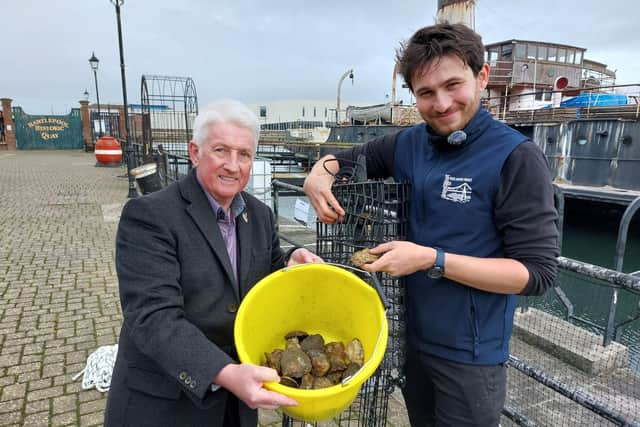

Tees Rivers Trust project manager Judy Power said: “This is our fourth nursery and the purpose of this is really to engage the public.
“Our other nurseries aren’t in as publicly accessible areas. This is somewhere where people can come and we can engage with them.
“Groups can learn about oysters, why they were lost locally and why it’s important to restore them to the Tees Estuary.”
Native Oysters were once common around the UK coast, but numbers have dropped by 95% over the last 100 years due to over fishing and reduced water quality.
The installation is part of a long-term programme to establish a native oyster reef within the estuary and reintroduce the once-abundant species.
Five tower cages holding around 30 oysters each, which have come from Scotland, have been placed in the dock behind the museum.
Ben Lamb from the Tees Rivers Trust described the moluscs as “true ecosystem engineers”.
Each oyster can filter up to 200 litres of water every day, helping to improve water quality and provide shelter and feeding opportunities for a variety of fish, crabs and other marine life.
Eventually the trust aims to move the cages into the Tees estuary channel to create a new oyster reef.
Councillor Rob Darby, Chair of Hartlepool Borough Council’s Housing, Growth and Communities Committee, said: “I think it’s a fantastic project.
“It’s the first time in a hundred years oysters have been back in the River Tees.
“It will be good for lobsters, crabs and the rest of crustacean species. All in all, it’s a win-win project.”